Google Analytics · last 30 days
Gems and jewellery store
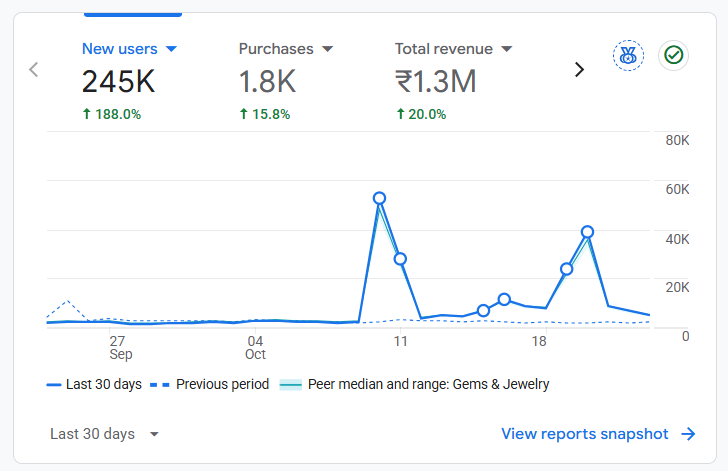
An online jewellery retailer. In the latest 30-day period, GA4 recorded 245K new users (up 188%), 1.8K purchases and ₹1.3M in revenue.
- E-commerce
- GA4
- Purchases
- Revenue


E-commerce SEO
Our e-commerce SEO services in India grow organic sales by fixing category structure, product pages and the technical issues that hold online stores back. In most online stores, the category pages bring in the bulk of organic revenue, not the homepage or the blog. Our e-commerce SEO work starts there. We structure categories around how shoppers search, fix the duplicate and filter URLs that waste crawl attention, strengthen product pages and keep product data clean, so you have a catalogue Google can understand and shoppers can buy from.
We work with Shopify, WooCommerce and custom-built stores.
Results
Here’s a gems and jewellery store we work with. These are the latest 30 days compared with the previous 30 days.
245K
New users
+188%
Growth in new users on the previous period
1.8K
Purchases
₹1.3M
Revenue recorded in GA4
 GA4
These figures cover all channels recorded in GA4 for the period, as published on our homepage. Results vary by category, competition, pricing and seasonality. The client’s name is private until approved.
Why stores stall in search
Every filter, sort option and product variant can create a new URL. A store with 500 products can easily end up with 50,000 crawlable addresses, most of them near-duplicates. Google spends its time on those, while the category pages you actually want ranked get less attention.
At the same time, product pages often reuse the manufacturer’s description, out-of-stock items return errors or vanish, and category pages are just a grid of products with no text. Fix those three problems and many stores see more pages indexed, better category rankings and more organic sales.
Filter URLs being indexed, thin category pages, duplicate product descriptions, out-of-stock pages deleted without redirects, missing product schema, and no internal links between related categories.
Organic revenue and transactions in GA4, category page clicks and rankings in Search Console, indexed product counts and product rich result eligibility.
Client work
An online jewellery retailer. In the latest 30-day period, GA4 recorded 245K new users (up 188%), 1.8K purchases and ₹1.3M in revenue.
Reviews
Rated 4.9 out of 5 on Google.
“We've had a good experience working with the team on our SEO and website optimization. They understand our requirements, communicate clearly, and are always helpful when we need support. The overall experience has been smooth and professional.”
 Divyansh Rajesh Jaiswal2ndRank
“The team has been helpful with our SEO work and website improvements. They understand our requirements and keep us updated on the tasks being handled. Communication has been smooth, and the overall coordination has been good.”
 Aastha BansalLetsTaxify
“We appreciate the team's approach to our website SEO and optimization work. They have been responsive to our requirements and helpful in discussing improvements. The coordination has been good, and the overall experience has been positive.”
 Vivek BhandariGlobesome
What’s included
The work depends on the size and structure of your catalogue. These are the six areas we cover.
We organise categories and subcategories around real search demand, so every valuable search has a page that can rank for it.
We decide which filter combinations deserve to be indexed and which shouldn’t be, then set canonicals, robots rules and internal links to match.
We improve product titles, descriptions, images and specifications so each page answers shoppers’ questions and stands apart from other sellers.
We add Product, Offer and Review markup that matches what’s on the page, so search results can show price, availability and ratings.
We set rules for discontinued, out-of-stock and seasonal products so you don’t lose rankings every time stock changes.
We write buying guides and comparisons that answer pre-purchase questions and link straight to the right categories.
Platforms
Every platform has its own SEO habits. Knowing them saves weeks of guesswork.
| Platform | Common SEO issues | What we fix |
|---|---|---|
| Shopify | Duplicate product URLs through collections, fixed URL folders, app bloat slowing pages | Canonical and internal link clean-up, collection page content, app audit, product schema |
| WooCommerce | Plugin conflicts, thin tag and attribute archives, slow hosting | Archive indexing rules, plugin review, caching and image fixes, category content |
| Custom-built stores | Filter URLs indexed in bulk, JavaScript rendering, missing basics like sitemaps | Faceted navigation rules, rendering checks, sitemap and schema set-up with your developers |
How it works
We fix the structure first, then work through categories and products in order of revenue potential.
We crawl the store, review the index and connect GA4 revenue data to each page type.
We resolve faceted navigation, canonicals and out-of-stock rules so Google focuses on the right pages.
We work through the highest-value categories first, then their top products.
Each month we report organic revenue, transactions and category performance, then set the next priorities.
Page roles
Mixing up their roles is one of the most common reasons stores struggle. Google’s e-commerce guidance follows the same logic.
| Category pages | Product pages | |
|---|---|---|
| Searches to target | Broad terms like “gold earrings for women” | Specific terms like a model name or “22k gold jhumka earrings” |
| Content | A short intro, buying help and FAQs above or below the grid | A unique description, specifications, sizing, delivery and returns |
| Structured data | BreadcrumbList | Product, with price, availability and reviews |
| Internal links | From the main menu and related categories | From their category and related products |
| Main goal | Rank for high-volume searches and send shoppers to products | Convert shoppers who already know what they want |
SEO and Shopping
Product titles, attributes, images and prices feed both your organic product pages and your Google Merchant Center listings. When the data is clean and consistent, both channels benefit. When it isn’t, products get disapproved in Shopping and struggle to rank organically.
We treat product data as one shared asset. Improvements made for SEO, such as clearer titles, complete attributes and accurate availability, also strengthen your Shopping campaigns and free product listings. The same clean data helps AI shopping tools describe your products accurately.
Tools
 Google Search ConsoleCategory and product query dataGoogle Analytics 4E-commerce revenue and transactions
 Screaming FrogCatalogue-wide crawls and duplicate detection

 Semrush and AhrefsCategory keyword research and competitor gaps
 Rich Results TestProduct schema validation
 PageSpeed InsightsTemplate speed on mobile
FAQs
Common questions from store owners and e-commerce managers.
Stores have far more pages, constantly changing stock and filters that create duplicate URLs. E-commerce SEO focuses on category structure, product data, faceted navigation and product schema, and it measures success in revenue and transactions as well as traffic.
E-commerce SEO runs on our monthly plans. Most stores choose Growth at ₹29,999 a month (or $999 internationally), excluding GST, because it includes category work, content and outreach. Large catalogues, several storefronts and international stores are quoted on scope. Every plan has a three-month minimum.
Yes. Each platform has its own SEO limits, such as Shopify’s fixed URL structure or WooCommerce’s dependence on plugins. We work within them and tell you when a change needs a developer or an app.
Not always. For large catalogues, start with your best-selling and highest-margin products and with the category pages. Manufacturer descriptions can stay on long-tail products until there’s time to improve them.
If a product is coming back, keep the page live, show its availability and suggest alternatives. If it’s gone for good, redirect it to the closest equivalent product or category. Deleting it outright throws away any rankings and links it had.
It can lower your reliance on paid traffic for searches where you rank well organically, but it rarely replaces ads entirely. Many stores use both and shift budget as organic rankings grow.
Structural fixes can show in Search Console within weeks. Category ranking gains typically take three to six months, depending on competition. Seasonal stores should start well before their peak season.
Yes. Short, useful category text and FAQs help search engines understand each page and help shoppers choose. We keep the product grid at the top so the copy doesn’t get in the way of shopping.
Rarely. Most SEO problems can be fixed on the platform you already have. If a re-platform is planned anyway, involve us early so URLs and rankings are protected during the move.
With indexing. We compare the number of pages Google has indexed with the number you actually want indexed. In many stores, filter and sort URLs far outnumber real category and product pages, which spreads Google’s attention thin. Once that’s under control, we move to category pages, then product pages.
Related
Our e-commerce SEO services in India start with a free store check. Share your store URL. We’ll check indexing, duplicates and your top categories, and send you the three fixes we’d prioritise.