


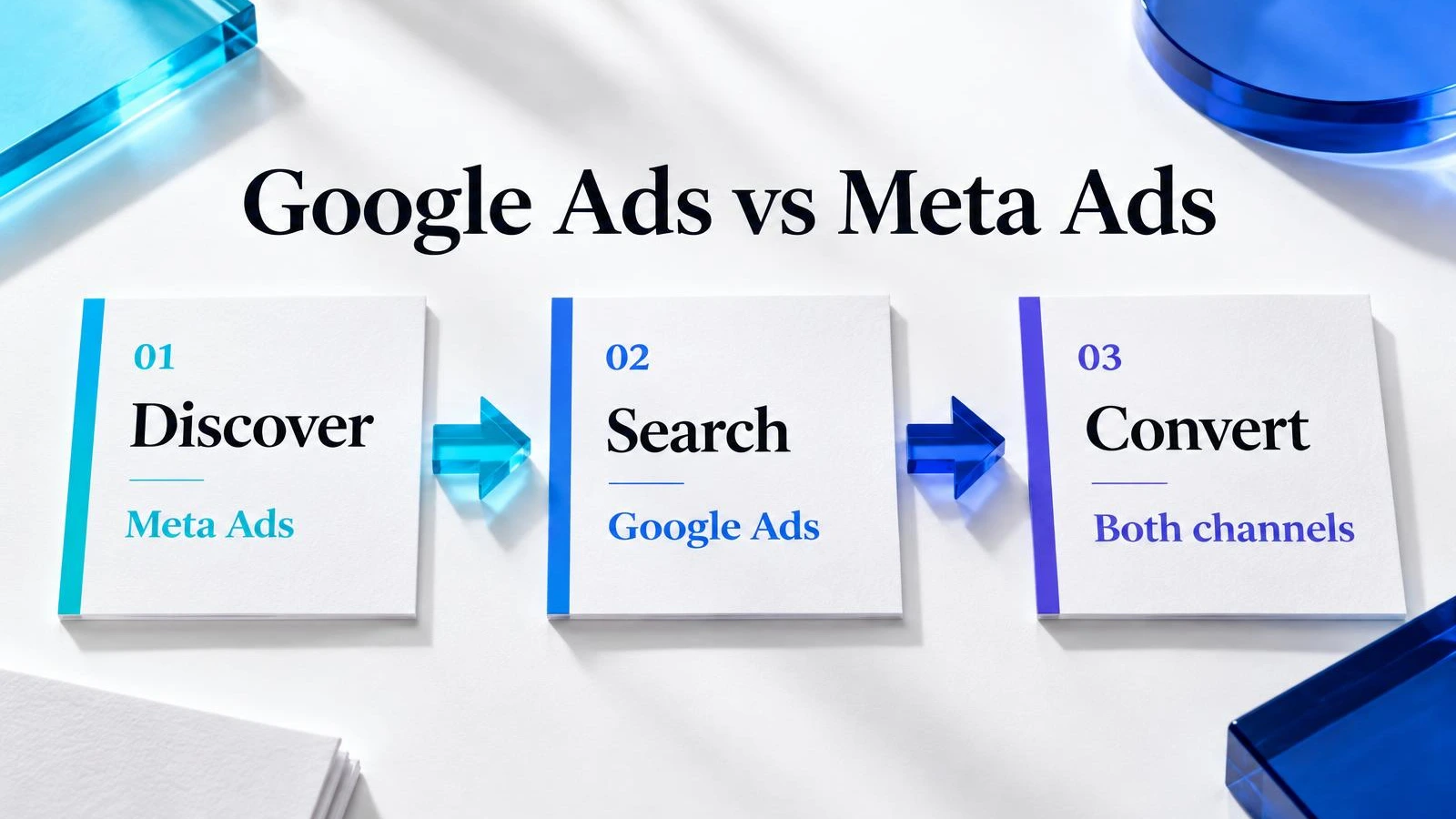
Google Ads is the better fit when buyers are already searching for your product or service and you want to capture active, high-intent demand. Meta Ads (across Facebook and Instagram) is the better fit when you need to introduce a visual or unfamiliar offer, build brand familiarity early in the customer journey, and generate demand among audiences who are not searching yet.
Choosing between search and social advertising is rarely about which platform is universally cheaper. Both platforms run on competitive auctions, and both can waste budget when matched to the wrong stage of buyer awareness. The practical decision depends on how your customers discover solutions, how quickly they decide, what creative assets your team can produce, and how accurately you track revenue back to each click.
1. Core Intent Differences: Capturing Demand vs Creating Demand
The single biggest difference between Google Ads and Meta Ads is what the user is doing when your advertisement appears. That behavioral context shapes click-through rates, conversion timelines, and sales follow-up requirements.
On Google Search, users type explicit queries because they have a problem to solve, a product to compare, or a local provider to hire. Someone searching for commercial accounting software or emergency dental care already knows what they need. Your advertisement answers an active request at the exact moment of intent.
On Meta platforms, users are scrolling through feeds, Stories, and Reels to connect with friends, watch entertainment, or browse interests. They are not actively looking to buy your service at that second. Your advertisement interrupts their scroll and sparks curiosity, meaning the ad itself must earn attention and explain why the offer matters.
| Dimension | Google Ads | Meta Ads |
|---|---|---|
| Core Mechanism | Intent-led demand capture (responds to active search queries and shopping signals) | Audience-led demand creation (reaches users based on interests, behaviors, and predictive signals) |
| Primary Placements | Google Search, Google Shopping, YouTube, Google Display Network, Maps, Gmail | Facebook Feed, Instagram Feed, Instagram Reels, Stories, Messenger, Audience Network |
| Buyer Mindset | Problem-aware or solution-aware; actively comparing options or ready to act | Passive discovery; may be unaware of your brand or category before seeing the ad |
| Primary Creative Lever | Keyword-to-ad relevance, clear headlines, ad assets, and fast landing pages | Visual hooks, short-form video, carousels, and clear value propositions |
| Typical Cost Dynamics | Often higher cost per click (CPC) in competitive niches, offset by higher purchase intent | Often lower cost per thousand impressions (CPM) and CPC, requiring stronger funnel nurturing |
| Scaling Ceiling | Bounded by existing monthly search volume for relevant keywords | Broadly scalable across active social users, limited primarily by creative fatigue and offer strength |
How Google's Auction Evaluates Search Intent and Ad Quality
Every time a user enters a search query, Google runs an auction to determine which ads appear and in what order. According to Google Ads documentation on Ad Rank, placement is not decided by bid alone. Google evaluates six factors: your maximum bid, the quality of your ad and landing page experience, minimum Ad Rank thresholds, auction competitiveness, the context of the user's search (such as location, device, and time), and the expected impact of ad assets like sitelinks or call extensions.
Because ad and landing page quality directly influence Ad Rank, a tightly structured campaign with relevant ad copy and a fast, focused landing page can often win a higher position at a lower actual cost per click than a competitor bidding more with a generic page.
How Meta's Delivery System Predicts Audience Interest
Meta's ad auction operates without search keywords. Instead, Meta evaluates a combination of advertiser bid, estimated action rates (how likely a specific person is to click, submit a form, or purchase based on historical behavior), and ad quality metrics such as engagement and negative feedback signals. When your visual creative resonates with a specific audience segment, Meta's delivery system identifies similar users and lowers delivery costs.
2. Audience Targeting and Reach Mechanics
Both platforms rely heavily on machine learning for ad delivery, yet the inputs you control as an advertiser remain distinct.
In Google Ads, targeting starts with what people look for and what they are actively researching. Search campaigns use keyword match types alongside negative keywords to filter out irrelevant queries. Performance Max and YouTube campaigns expand reach using audience signals, search themes, custom segments built around specific URLs or search terms, and demographic filters.
In Meta Ads, targeting centers on who people are and how they interact with content. Advertisers can guide delivery through broad targeting (allowing Meta's Advantage+ algorithms to find buyers based on conversion data), layered interest and behavioral categories, Custom Audiences built from website visitors or customer lists, and Lookalike Audiences modeled on existing high-value buyers.
For businesses selling niche B2B software or specialized industrial services with clear search terms, Google's keyword and search-theme signals provide direct access to active buyers. For consumer lifestyle brands, courses, or new product categories that people do not yet know to search for, Meta's behavioral and lookalike modeling unlocks reach that search simply cannot match.
3. Creative and Landing Page Requirements
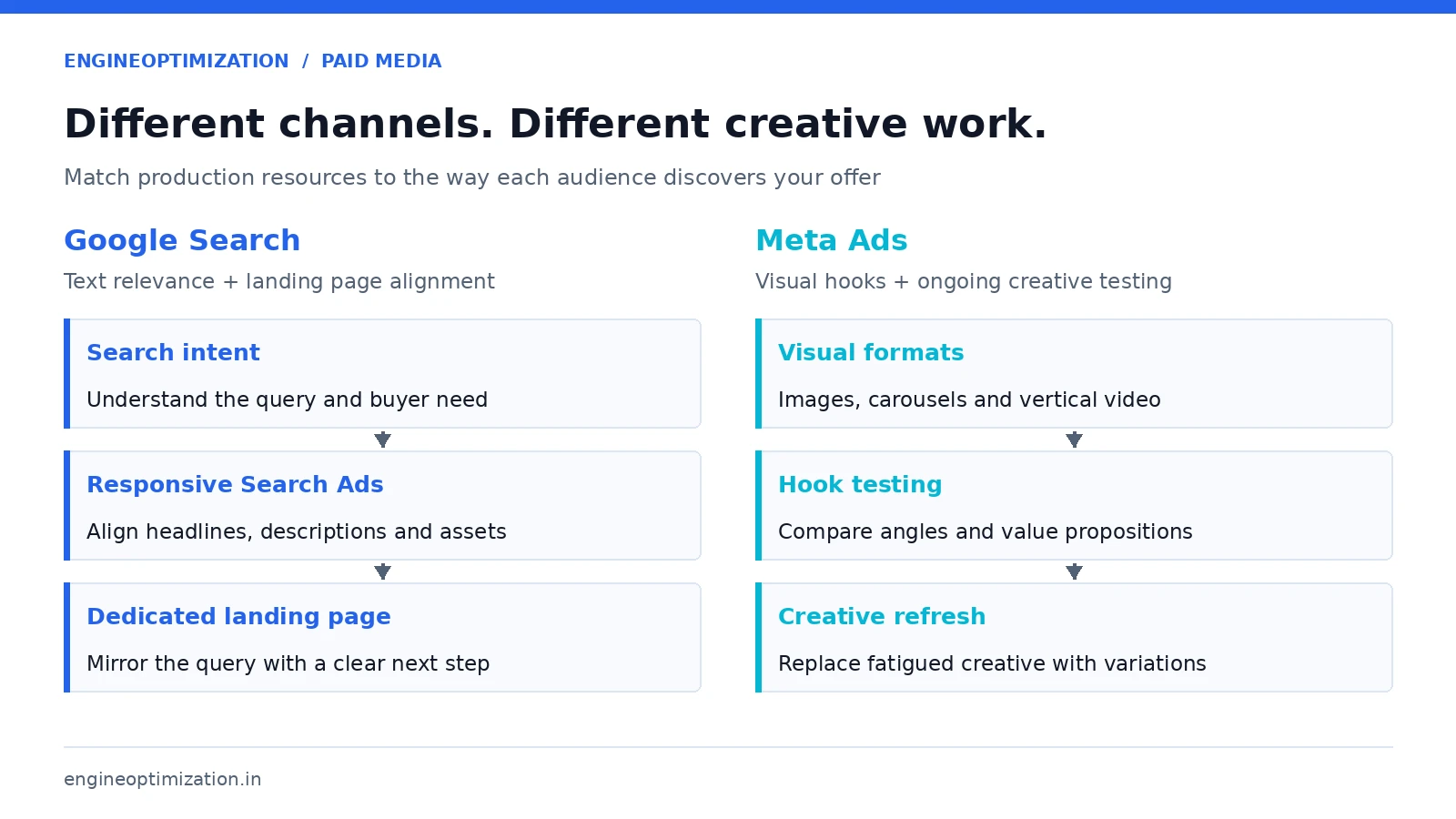
Many paid media campaigns underperform because businesses apply the same creative workflow to both platforms. Each channel demands a different production discipline.
Google Search campaigns are text-first. Success depends on matching search intent in your Responsive Search Ad headlines, highlighting clear differentiators in descriptions, configuring call and location assets, and sending clicks to a dedicated landing page that mirrors the searcher's exact query. While YouTube and Performance Max require video and image assets, core Search campaigns can launch quickly with strong copywriting and clean landing page architecture.
Meta Ads is a visual-first environment where your advertisement competes directly against content from friends, creators, and publishers. Static images, multi-card carousels, and vertical short-form videos carry the bulk of campaign performance. You typically have less than two seconds to stop a user from scrolling. Furthermore, Meta campaigns experience creative fatigue faster than Search campaigns. Running Meta Ads effectively requires ongoing creative testing, fresh hooks, and visual variations every few weeks rather than leaving a single ad running unchanged for months.
4. Google Ads vs Meta Ads for Lead Generation
Service businesses, B2B companies, clinics, and educational institutions frequently compare both channels for lead generation. While both generate enquiries, the sales operational requirements differ significantly.
Google Search generally delivers higher-intent enquiries because the prospect initiated the search. If a facilities manager searches for commercial HVAC maintenance in their city and submits a quote request, they already recognize the need and are actively shortlisting vendors. Cost per click is often higher, yet fewer leads are needed to close a deal.
Meta Ads often produces a higher volume of leads at a lower initial cost per lead, especially when using native Instant Forms that auto-fill a user's name, email, and phone number inside Facebook or Instagram. However, frictionless forms can also generate lower-intent enquiries from users who forget they submitted their details. To make Meta lead generation profitable, businesses need clear qualification steps:
- Introduce Intentional Friction: Add custom qualifying questions or conditional logic to Instant Forms, or send traffic to a dedicated conversion landing page so prospects read your offer before submitting.
- Enforce Fast Follow-Up: Connect Click-to-WhatsApp ads or lead forms directly to your CRM so sales representatives respond within minutes rather than hours.
- Optimize for Qualified Outcomes: Feed offline CRM milestones (such as qualified appointments or closed deals) back into Google Ads and Meta Ads so automated bidding optimizes for revenue rather than raw form fills.
5. Google Ads vs Meta Ads for E-commerce
Online stores rarely rely on a single paid channel once they move past initial validation, because Google and Meta serve complementary roles in product discovery and checkout.
Google Shopping Ads and Performance Max campaigns capture shoppers searching for specific product names, brands, specifications, or category terms. Because Google matches ads using your Google Merchant Center product feed rather than manual keywords alone, feed accuracy is critical. Complete product titles, GTINs, pricing, availability, and clean product imagery determine whether your products appear when a shopper is ready to buy.
Meta Ads excels at visual merchandising, product storytelling, and impulse or considered discovery. Dynamic product catalog ads (Advantage+ catalog campaigns) automatically display relevant items to new shoppers and retarget visitors who viewed a product or abandoned a cart. Short-form product demonstrations, unboxing clips, and customer-style video reviews help shoppers picture the product in daily use before they ever type a brand name into Google.
6. Budget Allocation: How to Decide Where to Spend First
Neither platform is automatically cheaper across every industry. A low cost per click on Meta does not help if none of those clicks turn into paying customers, and a high cost per click on Google can be highly profitable if one closed client covers weeks of ad spend. Evaluate your starting allocation across four practical criteria:
- Existing Search Demand: Check whether buyers actively search for your product or service category. If clear, high-intent search volume exists, starting with Google Search captures the lowest-hanging revenue first.
- Visual Appeal and Novelty: If your offering is visually compelling, solves a latent problem, or introduces a new category without established search volume, start with Meta Ads to educate and build demand.
- Creative Production Capacity: Avoid launching Meta Ads without a realistic plan to produce and refresh image and video variations. If your team has strong copy and service pages but limited design bandwidth, Google Search is easier to sustain initially.
- Budget Concentration Threshold: Splitting a modest monthly test budget equally across two platforms often starves both algorithms of the conversion volume needed to exit the learning phase. Concentrate your initial budget on the single channel that best matches your buyer journey, prove unit economics, and expand to the second channel once conversion tracking is verified.
When planning monthly Google Ads spend, remember how Google's daily budget pacing works. According to Google Ads budget guidelines, Google may spend up to two times your average daily budget on high-traffic days to capture extra demand, while capping your total monthly charge at 30.4 times your average daily budget. On Meta, daily budgets also fluctuate slightly around your daily target based on auction opportunities, so judge pacing over weekly and monthly windows rather than single-day swings.
If you want help modeling realistic search click costs and keyword volume before launching, explore our Google Ads Management services. If your priority is testing visual hooks, audience segments, and paid social funnels, review our Meta Ads Management services.
7. Measurement and Attribution Across Both Platforms
Running Google Ads and Meta Ads side by side often creates a reporting conflict: each platform uses its own attribution window and claims credit for conversions it touched. Relying solely on inside-platform dashboards can lead to double-counting the same customer.
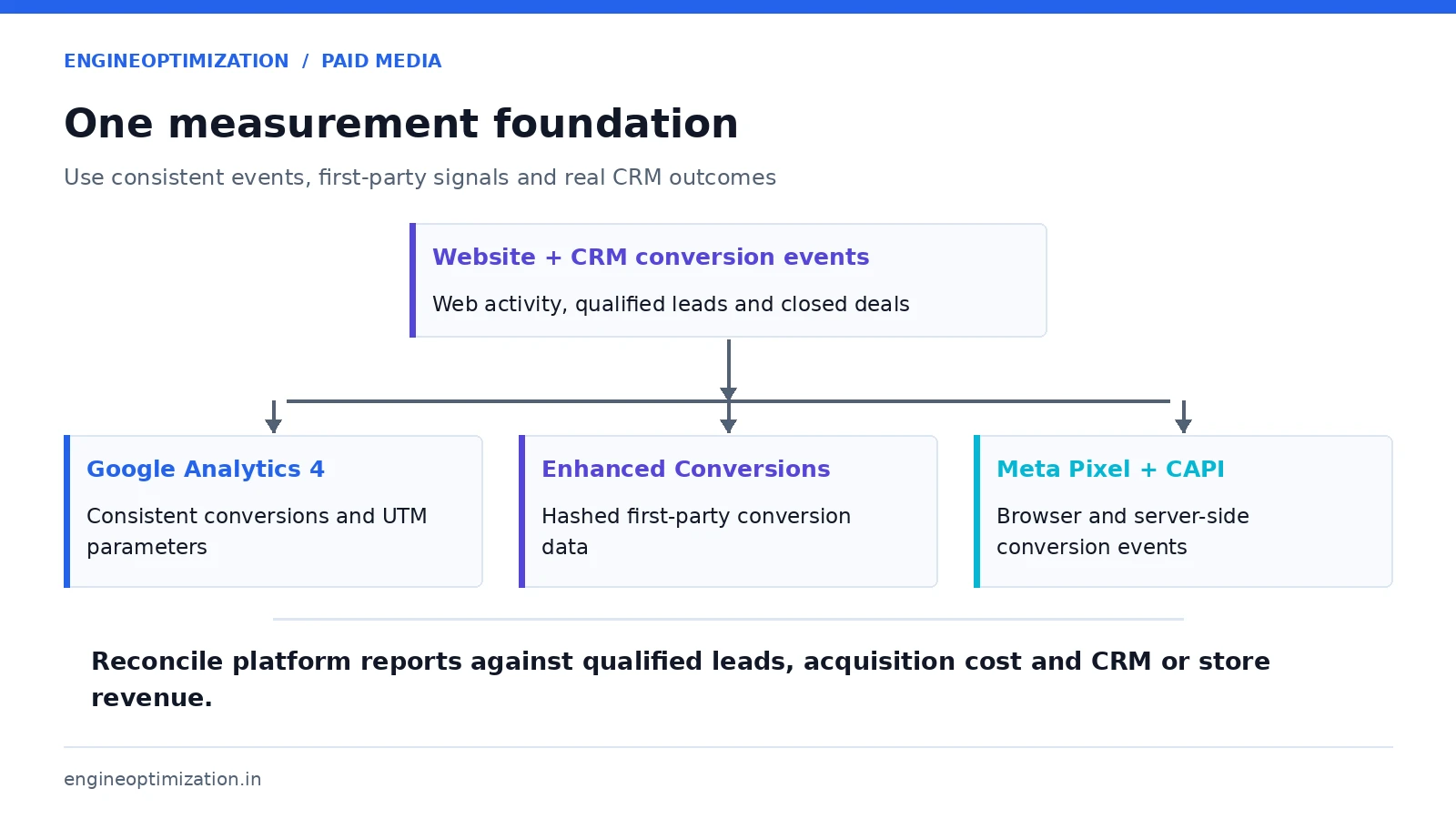
To compare channels fairly, build a unified measurement foundation before scaling spend:
- Neutral Analytics Baseline: Track website conversions consistently in Google Analytics 4 (GA4) with standardized UTM parameters across every Google and Meta campaign so you have one neutral baseline.
- First-Party Signal Resilience: Browser privacy restrictions and cookie limitations reduce traditional tag visibility. Implement Google Enhanced Conversions alongside the Google tag to match hashed first-party conversion data securely, and deploy the Meta Conversions API (CAPI) alongside the Meta Pixel to send server-side web and CRM events.
- CRM and Revenue Reconciliation: Compare channels by Cost Per Qualified Lead (CPQL), Customer Acquisition Cost (CAC), and actual revenue recorded in your CRM or store backend rather than platform-reported clicks or unverified leads.
8. How to Combine Google Ads and Meta Ads in One Funnel
For most growing businesses, the strongest long-term paid media strategy is not choosing Google or Meta permanently, but assigning each channel a clear job across the customer journey:
- Stage 1 (Awareness and Discovery): Use Meta Ads video, carousel, and educational creative to introduce your brand to cold audiences who match your ideal buyer profile.
- Stage 2 (Active Search Capture): As prospects become familiar with your solution, many will search Google for your brand name, product category, or reviews. Capture those high-intent queries with Google Search and Shopping campaigns so competitors do not intercept the demand your social ads created.
- Stage 3 (Cross-Channel Retargeting): Use Meta retargeting and Google Display or YouTube remarketing to stay visible to high-intent website visitors who did not convert on their first visit, addressing common objections with proof, comparisons, or clear next steps.
- Stage 4 (Blended Budget Optimization): Review blended acquisition cost and assisted conversions monthly, shifting incremental budget toward whichever channel is producing qualified pipeline at the healthiest margin.
Frequently Asked Questions About Google Ads vs Meta Ads
Google Search often generates high-intent enquiries faster when people are already searching for your exact service, because your ads appear in front of buyers at the moment of need. Meta Ads can generate reach and initial leads within days, though finding winning creative angles and audience combinations typically takes two to four weeks of structured testing.
Meta Ads frequently has a lower cost per click and lower cost per thousand impressions than competitive Google Search keywords, but lower click cost does not guarantee a lower cost per customer. Because Google traffic carries stronger immediate purchase intent, a higher-priced Google click can still produce a lower overall Customer Acquisition Cost depending on your offer and landing page conversion rate.
Yes, provided campaigns are structured for B2B buying cycles. While Google Search captures active bottom-funnel software or service queries, Meta Ads works well for promoting industry guides, webinars, case studies, and retargeting decision-makers who visited your website, especially when paired with CRM offline conversion tracking.
There is no universal fixed minimum, because required spend depends on your industry click costs and target cost per acquisition. As a practical rule, each active campaign needs enough daily budget to generate consistent conversion signals for platform algorithms to optimize. If your monthly budget is tight, validate one primary channel first before splitting spend across both platforms.
Use a dedicated landing page when your offer requires detailed explanation, pricing context, or higher buyer commitment, as it filters out accidental submissions. Use Meta Instant Forms when speed and mobile convenience are top priorities, and add qualifying questions so your sales team focuses on serious prospects.