


A business website can attract visitors and still fail to generate enquiries. The reason is often not a lack of SEO activity. It is a lack of strategy. Publishing blogs, building backlinks and changing title tags without a clear business objective can create activity without meaningful results.
An effective SEO strategy for business websites connects what potential customers search for with the pages that help them make a decision. It also gives your team a clear order of work: what to fix first, which pages to improve, what content to create and how to measure whether SEO is contributing to the business.
This guide explains how to build that plan, whether you manage SEO internally or work with an external specialist.
What is an SEO strategy for a business website?
An SEO strategy is a structured plan for improving a website's visibility in relevant organic search results and turning that visibility into useful business outcomes, such as qualified enquiries, calls, demo requests, bookings or sales.
It is more than a list of SEO tasks. A strategy explains why each task matters, which audience or search need it supports, which page should address it, who is responsible and how success will be measured.
For example, a B2B consulting firm may want more enquiries from companies looking for compliance support. Its strategy could prioritise service-page improvements, technical fixes that prevent important pages from being indexed, and practical articles answering questions buyers ask before contacting a consultant.
The goal is not to attract every possible visitor. It is to become visible to the right people when they are researching a problem your business can solve.
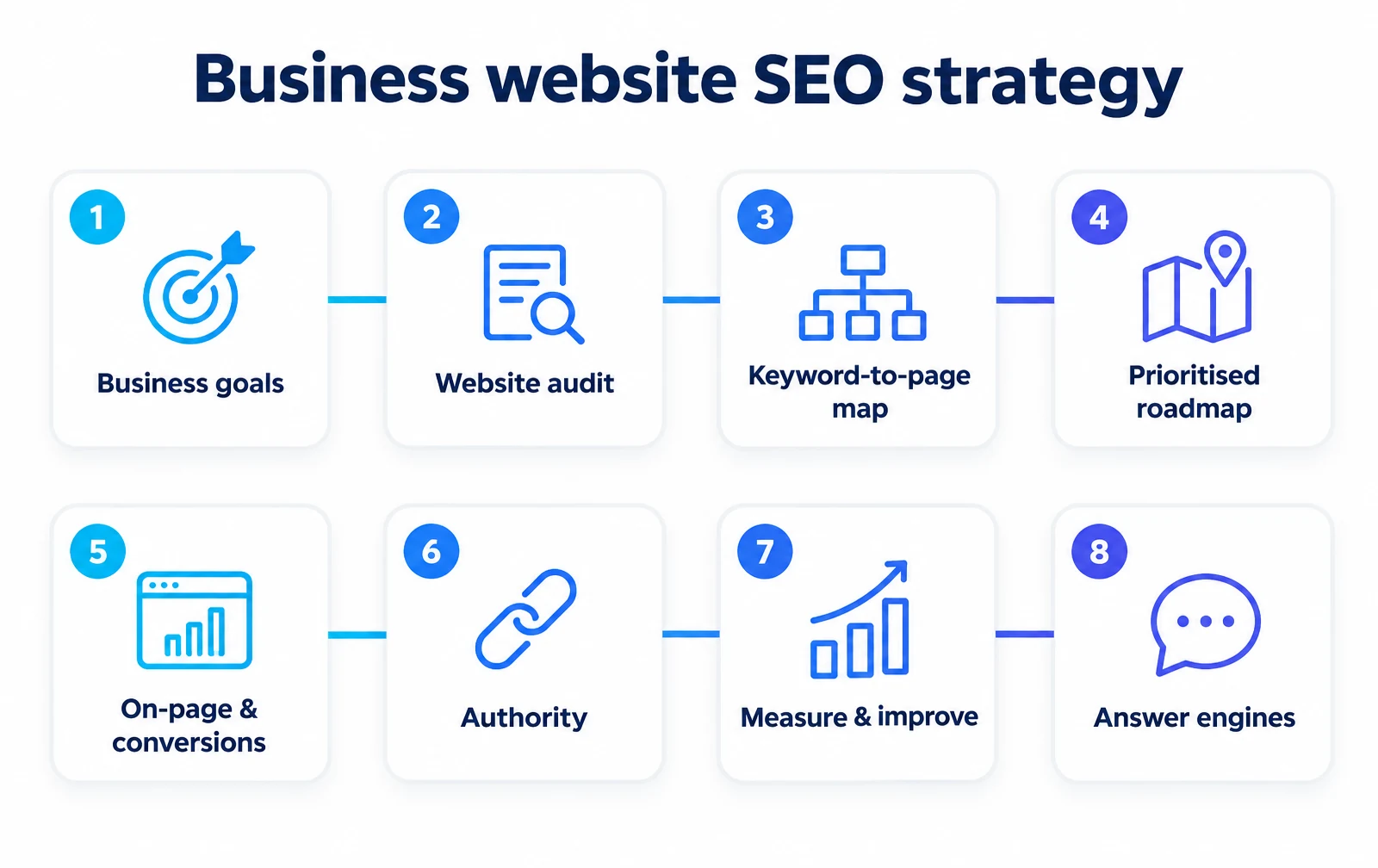
1. Start with business goals, not rankings
Before choosing keywords or planning content, decide what the business needs SEO to contribute. A target such as 'increase organic traffic by 50%' describes a channel metric, not necessarily a business result. More traffic is useful only when it reaches the right audience and supports a meaningful action.
Define the outcome you want
- Service businesses: qualified contact-form submissions, calls, quote requests or booked consultations.
- B2B companies: relevant demo requests, sales-qualified leads or opportunities influenced by organic search.
- E-commerce websites: organic revenue, transactions, product discovery and profitable category traffic.
- Local businesses: calls, direction requests, appointment bookings and enquiries from the service area.
Choose supporting indicators
Use organic clicks, impressions, rankings, landing-page engagement and conversions to understand what is happening. These are diagnostic indicators. Review them alongside lead quality and sales feedback so the team can distinguish useful growth from irrelevant visits.
Set a baseline before work begins. Record the measurement period, conversion definitions, important landing pages and any known tracking gaps. Without a baseline, it is difficult to tell whether a change represents genuine improvement.
2. Audit the website before creating a new plan
A website audit helps identify what is already working, what is holding performance back and where effort is likely to have the greatest impact. Do not assume that every issue needs to be fixed before SEO can begin. Prioritise issues according to their effect on important pages and business goals.
Review the technical foundation
- Crawlability: Can search engines discover the important pages through internal links and site navigation?
- Indexability: Are priority pages allowed to be indexed, and are canonical tags pointing to the intended URLs?
- Sitemaps and robots.txt: Does the XML sitemap include the correct canonical URLs, and does robots.txt avoid blocking pages that should be crawled?
- Redirects and errors: Are there broken internal links, redirect chains, unnecessary redirects or important 404 pages?
- Mobile experience and performance: Is the website usable on mobile, and do key templates provide a stable, responsive experience?
- Structured data: Is relevant schema implemented accurately and consistent with visible page content?
Use Google Search Console to review indexing and search performance. A crawler can help find internal linking, status-code, canonical and page-structure issues. PageSpeed Insights can provide field and lab performance information where available.
Review existing content and landing pages
List the pages that matter commercially: service pages, product or category pages, location pages and high-value informational resources. For each page, review its purpose, target audience, search intent, content quality, internal links, calls to action and organic performance.
Look for pages that target the same query or solve the same user need. Two similar pages can compete with each other or make it unclear which URL should rank. The solution may be to differentiate their intent, consolidate overlapping content or improve internal links—not automatically to publish another page.
3. Research keywords and map them to the right pages
Keyword research identifies the language people use when looking for products, services and information. Strategy begins when you decide which of those searches matter to your business and which page should answer each one.
Group keywords by intent
- Informational: the searcher wants to understand a topic or solve an early-stage problem.
- Commercial investigation: the searcher is comparing providers, approaches or solutions.
- Transactional: the searcher is ready to buy, book, request a quote or contact a provider.
- Navigational: the searcher is trying to reach a particular brand or website.
Search intent should guide the page format. A broad question may need a detailed guide; a service query usually needs a clear service page with scope, proof, process and a relevant enquiry path.
Create a keyword-to-page map
Assign one primary search theme and a clear purpose to each important URL. Supporting phrases can be included naturally when they belong to the same topic and intent. Do not force every variation into a separate page.
| Page type | Example search theme | Page purpose |
|---|---|---|
| Main service page | SEO services | Explain the service, process, expertise and how to enquire. |
| Specialist service page | Technical SEO services | Explain technical scope, common problems and specialist support. |
| Educational blog | How to build an SEO strategy for a business website | Help a business understand the planning process and next steps. |
| Case study | SEO results for a comparable business | Show verified work, context, actions and outcomes. |
This mapping reduces duplication and gives each page a defined role. For example, an educational article about building an SEO strategy should explain the planning process and link to the commercial SEO Services page. It should not attempt to replace that service page.
4. Build a prioritised SEO roadmap
A useful SEO roadmap sequences work according to business impact, urgency, effort and dependencies. Fixing a page that cannot be indexed may be more important than publishing five new articles. Improving a service page that already attracts relevant impressions may be more valuable than chasing a broad keyword with little buying intent.
| Priority | Typical work | Why it matters |
|---|---|---|
| 1. Critical blockers | Resolve accidental noindex directives, crawl blocks, incorrect canonicals, major redirect errors or broken priority pages. | Important pages must be accessible and eligible to appear in search. |
| 2. High-value pages | Improve key service pages, page intent, titles, headings, proof, content clarity and enquiry paths. | Connect existing demand with the pages most likely to generate business. |
| 3. Content opportunities | Publish useful supporting guides, comparison content and answers to genuine customer questions. | Build topical coverage and support the buyer research journey. |
| 4. Authority and reputation | Earn relevant editorial mentions, links, reviews and credible third-party references. | Strengthen discovery, reputation and the signals that help people assess the business. |
| 5. Continuous improvement | Refresh declining pages, test conversion paths and refine the roadmap using performance data. | Keep the strategy aligned with changes in demand and business priorities. |
A practical first 90-day SEO roadmap
| Period | Focus | Example deliverables |
|---|---|---|
| Days 1–30: Foundation | Understand the business, establish measurement, audit the site and map keywords to URLs. | Baseline report; technical issue list; priority page map; conversion tracking review; approved roadmap. |
| Days 31–60: Optimisation | Fix high-impact issues and improve the most important existing pages. | Technical fixes; revised service pages; improved internal links; content briefs; updated metadata. |
| Days 61–90: Growth and evaluation | Publish selected supporting content, build relevant authority and evaluate early performance. | New content; outreach activity; refreshed pages; lead-quality review; next-quarter priorities. |
This is a planning framework, not a promise that rankings or leads will improve within 90 days. The pace depends on the site's condition, competition, search demand, implementation capacity and how quickly search engines recrawl and reassess changes.
5. Strengthen on-page SEO and conversion paths
On-page SEO helps users and search engines understand what a page offers. It should make the page more useful, not simply repeat a keyword.
- Write a descriptive title tag and a clear H1 that accurately reflect the page's purpose.
- Organise the content with logical H2 and H3 headings that answer real user questions.
- Explain services clearly: who they are for, what is included, how the process works and what a customer should expect.
- Add relevant internal links using natural anchor text that describes the destination.
- Use descriptive image filenames and alt text when images convey useful information.
- Include proof that can be verified, such as real case studies, client feedback, team experience or process details.
- Make the next step clear with a relevant CTA, accessible contact details and a form that works.
A page can rank and still fail commercially if visitors cannot understand the offer or find a sensible next step. Review the page as a potential customer would: is the service clear, is the business credible, and is it easy to make an enquiry?
6. Build authority through useful content and relevant links
Authority is not created by collecting the largest possible number of backlinks. Focus on earning recognition that makes sense for the business, its expertise and its market.
- Publish original resources that answer customer questions with useful detail and practical examples.
- Create case studies that explain the starting situation, work completed, timeframe and verified outcomes.
- Contribute expert commentary or useful resources to relevant industry publications and professional communities.
- Keep business information consistent across important profiles and directories where appropriate.
- Review backlink quality and relevance; avoid schemes that promise rankings through bulk, automated or unrelated links.
Content and link acquisition should support the same positioning. If the business specialises in a particular service or industry, its website and external references should make that expertise easy to understand.
7. Measure SEO performance and improve the plan
A strategy needs a regular review cycle. Use Google Search Console to understand search visibility and Google Analytics 4 or another analytics platform to assess what visitors do after landing on the website. Make sure important conversions are configured and tested before relying on them.
| Measurement area | What to review | Business question |
|---|---|---|
| Search visibility | Clicks, impressions, query themes, CTR and average position. | Are the right pages appearing for relevant searches? |
| Landing pages | Organic entrances, engagement and next-page actions. | Are visitors reaching useful pages and exploring the offer? |
| Conversions | Form submissions, calls, bookings, demo requests and sales where tracked. | Is organic search contributing to meaningful actions? |
| Lead quality | Qualified versus unqualified enquiries, sales feedback and pipeline contribution. | Are the enquiries commercially relevant? |
| Technical health | Indexing, crawl issues, page experience and important template errors. | Can search engines access the pages that matter? |
| Authority and reputation | Relevant referring domains, brand mentions, reviews and earned coverage. | Is the business building credible recognition in its market? |
Review performance monthly, but avoid reacting to every short-term movement. Compare like-for-like periods, account for seasonality and campaign changes, and investigate which pages and queries explain a meaningful change. If traffic rises but qualified leads do not, review search intent, landing-page relevance, offer clarity and conversion tracking before simply publishing more content.
8. Make your content useful for answer engines as well
People increasingly discover information through search summaries and conversational answer tools as well as traditional search results. There is no separate shortcut that guarantees inclusion in these systems. The practical foundation remains clear, accurate, well-structured information that demonstrates real expertise.
- Answer the main question directly near the beginning of the relevant section.
- Use descriptive headings, concise explanations, meaningful examples and clearly labelled tables where they improve understanding.
- Support factual claims with trustworthy sources and keep important information current.
- Show who is responsible for the content and provide accurate author or reviewer credentials where relevant.
- Use consistent business and service descriptions across the website.
- Add structured data only when it accurately represents visible page content and follows the relevant search engine guidelines.
These practices can make information easier for people and systems to interpret, but they do not guarantee an AI Overview, featured snippet or answer-engine citation.
Common SEO strategy mistakes to avoid
- Choosing keywords only because a tool reports high search volume, without checking intent or business relevance.
- Creating multiple pages for nearly identical searches without a distinct purpose for each page.
- Building backlinks in bulk without evaluating relevance, editorial quality or risk.
- Publishing articles while important service pages or technical problems remain unresolved.
- Measuring success only through rankings, impressions or total sessions.
- Promising a fixed ranking position or guaranteed lead volume without evidence.
- Changing URLs, titles or page content repeatedly without a clear reason or performance review.
How often should you review an SEO strategy?
Review the roadmap at least monthly and revisit the wider business objectives quarterly or when the business changes its services, target markets, pricing or priorities. A review does not mean changing everything every month. Keep work that is progressing, investigate work that is not, and adjust priorities when new evidence justifies it.
Frequently asked questions
A practical SEO strategy should include business goals, audience and search-intent research, a website audit, keyword-to-page mapping, technical SEO, on-page improvements, content planning, authority building, conversion tracking and a measurement process.
Yes. A small business can begin by defining its priority services, understanding customer searches, improving its most important pages, fixing major technical issues and tracking enquiries. Specialist support may be useful when the website has complex technical problems, operates in a competitive market or lacks the time and expertise to execute the plan.
There is no universal timeline. Results depend on the website's history and condition, competition, search demand, the quality and pace of implementation, and how search engines respond to changes. Track progress over time rather than treating a fixed number of weeks as a guarantee.
No. Keyword research identifies search opportunities, but a strategy decides which opportunities matter, which pages should target them, what needs to be improved first and how performance will be evaluated.
No. Closely related keywords with the same intent can often be addressed by one strong page. Create a separate page when the search intent, audience need or offering is genuinely different.
Track relevant organic clicks and impressions, landing-page performance, qualified enquiries, calls or sales, conversion rates, indexing health and lead quality. Choose metrics that connect search activity to the business outcome.
Conclusion: Build an SEO plan around the business
A strong business website SEO strategy gives every activity a purpose. It starts with the customers and outcomes that matter, identifies what is preventing the website from performing, maps search demand to the right pages and prioritises work that can make a measurable difference.
Instead of treating SEO as a collection of disconnected tasks, build a roadmap, implement it in a sensible order and review the results with business data. That is how a website can move beyond attracting visits and become a more effective source of qualified opportunities.