

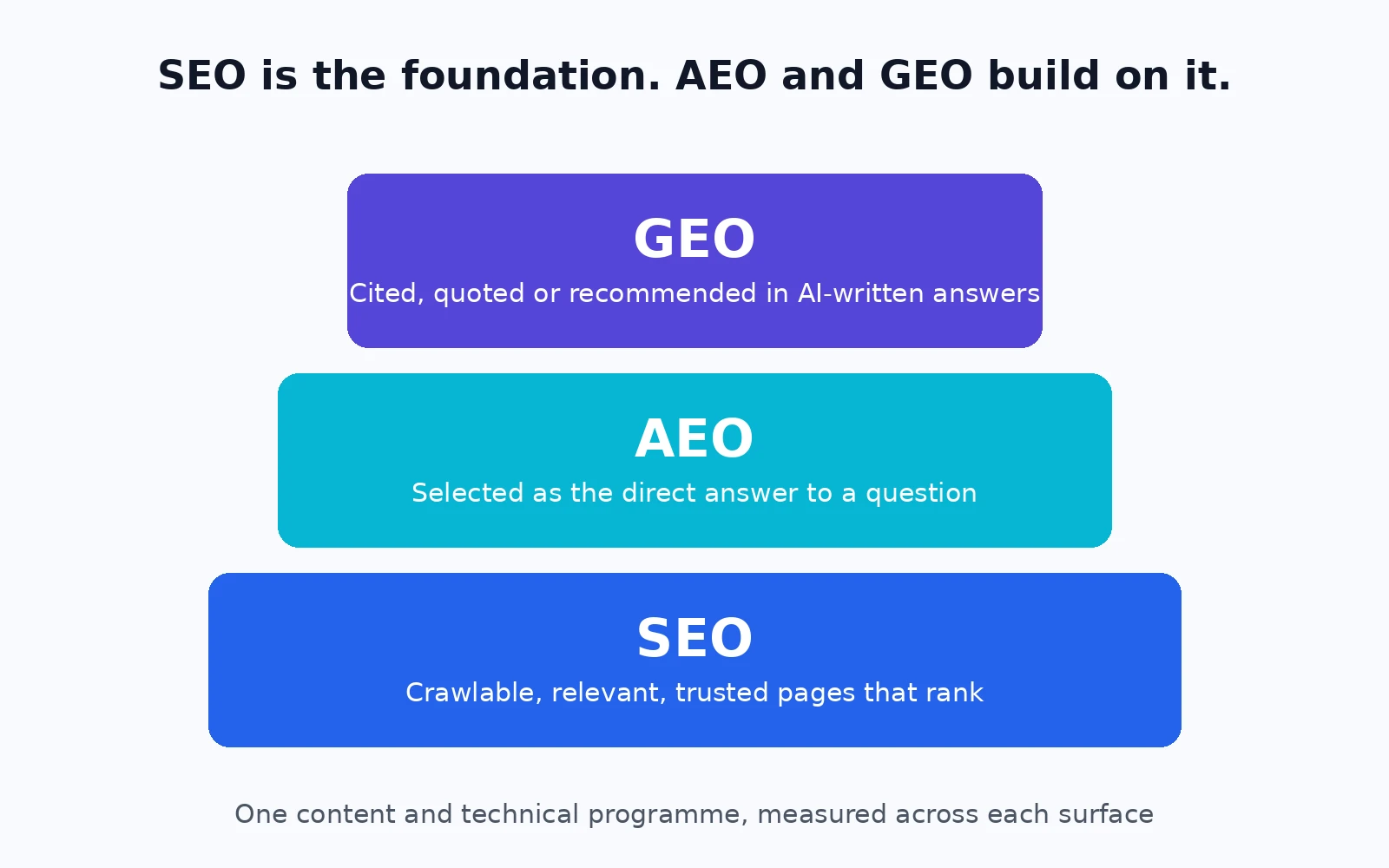
AEO vs GEO vs SEO comes down to where your content appears. SEO helps your pages rank in search results. Answer engine optimization (AEO) helps your content become the direct answer to a question. Generative engine optimization (GEO) helps your content get cited or mentioned inside AI-written responses from tools such as Google AI Overviews, ChatGPT search and Microsoft Copilot. In practice, most of the work is shared, and good SEO remains the base that the other two depend on.
The difficulty for businesses is that these labels are used loosely. Agencies sell them as separate services, software vendors define them to suit their products, and Google itself says that optimising for its AI features is simply SEO. This guide sets out what each term means, where the boundaries genuinely sit, what the official documentation from Google, Microsoft and OpenAI says, and what is worth doing first.
AEO vs GEO vs SEO at a glance
| SEO | AEO | GEO | |
|---|---|---|---|
| Full name | Search engine optimisation | Answer engine optimization | Generative engine optimization |
| Main goal | Rank pages in search results and earn clicks | Be selected as the direct answer to a question | Be cited, quoted or recommended inside an AI-generated response |
| Where it shows | Organic results in Google and Bing | Featured snippets, voice answers, AI Overviews, short AI answers | AI Overviews, AI Mode, ChatGPT search, Copilot, Perplexity, Gemini |
| Unit of success | A ranking and a click | An answer selected from your page | A citation, link or brand mention |
| Core work | Crawlability, relevance, content quality, authority | Clear questions and direct answers, logical structure | Original evidence, entity clarity, consistent information across the web |
| Main measurement | Search Console, analytics, rank tracking | Search Console, manual checks of answer features | Search Console Generative AI report, Bing AI Performance, referral data, prompt sampling |
| Term origin | Mid-1990s | Late 2010s (voice and snippets), widened since | 2023 research paper by Aggarwal and colleagues |
What is SEO, and why does it still come first?
Search engine optimisation is the work of making a website easy for search engines to crawl, understand and trust, so its pages appear for relevant searches. It covers technical health (crawling, indexing, speed, mobile usability), on-page relevance (content that matches what people are looking for) and authority (signals that others trust your site, such as links and mentions).
SEO comes first because AI search features are built on top of search indexes. Google states that the same SEO best practices apply to AI Overviews and AI Mode, and that a page must be indexed and eligible to show a snippet before it can appear as a supporting link in those features (Google Search Central: AI features and your website). Google’s newer guide to optimising for generative AI features explains that these features rely on Google’s core ranking and quality systems.
Put simply, if a page is blocked, slow to render, thin or hard to understand, it is unlikely to be ranked or cited anywhere. If your website still has crawl problems or weak service pages, those are the first priority. Our SEO services cover that foundation.
What is answer engine optimization (AEO)?
Answer engine optimization is the practice of structuring content so that a search engine or assistant can lift a clear, accurate answer from it. The term grew up in the late 2010s around featured snippets, People Also Ask boxes and voice assistants, where one answer is read out or shown above the normal results. Many practitioners now use it more broadly to include AI Overviews and other short AI answers.
AEO work is mostly editorial:
- Use headings that match the questions customers actually ask.
- Answer each question in the first one or two sentences under its heading, then add detail.
- Define terms plainly, keep figures specific and dated, and use tables where readers compare options.
- Make each section understandable on its own, because an answer may be shown without the surrounding page.
If your business wins most of its enquiries from people asking specific questions before they buy, structured answers matter. Our answer engine optimization service focuses on this kind of content work.
One acronym, two meanings
You may also see AEO expanded as “agentic engine optimization”. Microsoft Advertising uses it this way in its 2026 retail guide, From Discovery to Influence: A Guide to AEO and GEO. There, AEO is about making product and business information clear and accurate enough for AI assistants and agents to understand and act on, for example when comparing products or completing a task for a shopper. Microsoft’s summary of the roles is useful: SEO helps a product get found, AEO helps the AI explain it clearly, and GEO helps the AI trust and recommend it. When someone uses the term, ask which meaning they intend.
What is generative engine optimization (GEO)?
Generative engine optimization is the work of improving how often, and how accurately, your content and brand appear in answers written by generative AI systems. The term was introduced in a 2023 research paper by Pranjal Aggarwal and colleagues from Princeton University, IIT Delhi and other institutions, later presented at the KDD 2024 conference (GEO: Generative Engine Optimization, arXiv).
The paper describes a generative engine as a system that retrieves sources through a search engine and then uses a language model to write one combined answer with citations. In the authors’ benchmark tests, adding citations, quotations from relevant sources and statistics to content improved its visibility in generated answers by up to 40%, and the effect varied by subject area. That finding comes from controlled experiments, so treat it as a sign of what generative engines tend to value (specific, supported information) rather than a promised result.
GEO goes further than AEO in two ways. First, success is often a mention or citation rather than a click. Second, what other websites say about your business matters, because an AI answer may draw on reviews, directories, news coverage and comparison articles as well as your own pages. Consistent business information across the web, and genuine third-party coverage, become part of the work. Our generative engine optimization service looks at both your own content and how your business is represented elsewhere.
Are AEO and GEO really different disciplines?
There is no settled answer, and it is worth knowing the three positions you will meet:
- They are different. AEO targets answer slots on search surfaces; GEO targets citations inside conversational AI responses. This view is common among agencies that price them separately.
- They are the same work under two names. Some AI visibility software companies argue that the tactics overlap so completely that the distinction is just marketing.
- It is all SEO. Google’s guide says that, from its point of view, optimising for generative AI search is optimising for the search experience, so it remains SEO. Google acknowledges AEO and GEO as common industry terms but advises focusing on effective SEO rather than “AEO/GEO hacks”.
Microsoft takes a slightly different line. Bing rewrote its Webmaster Guidelines in early 2026 to name generative engine optimization as a concept and to explain how content can serve as a grounding source for Copilot answers.
For a business, the practical conclusion is the same whichever view you take: run one content and technical programme, then measure the different surfaces separately. Paying for three disconnected programmes usually means paying for the same work more than once.
How AI search chooses its sources
Understanding the mechanics helps you judge advice. Nobody outside these companies knows the exact selection criteria, but each platform publishes enough to show the general process.
Google AI Overviews and AI Mode
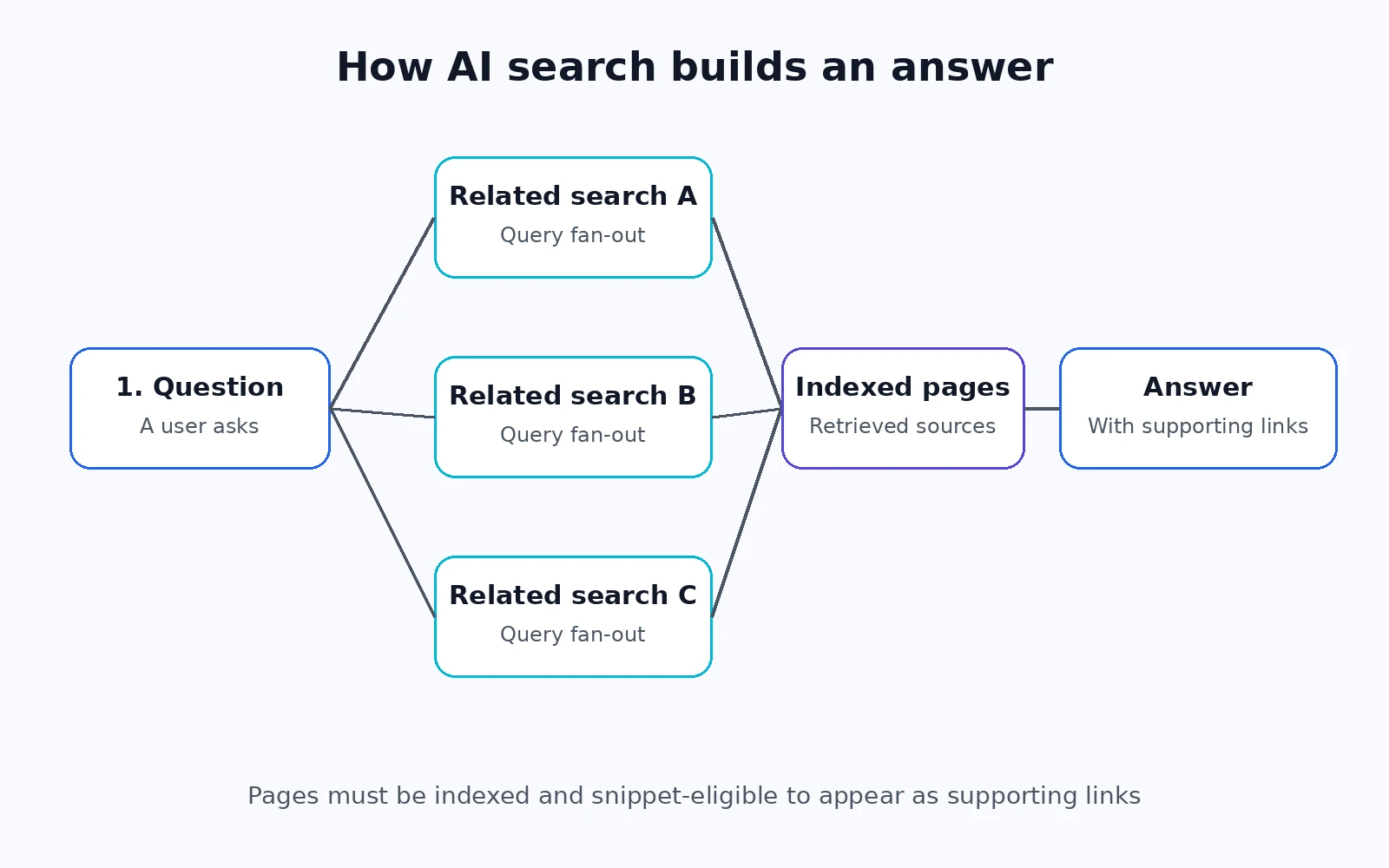
Google describes two techniques. The first is retrieval-augmented generation, also called grounding: the system retrieves relevant, current pages from the Search index and shows links that support the answer. The second is query fan-out: the system runs several related searches across subtopics at the same time to build a fuller response. Google’s own example is a question about fixing a weedy lawn fanning out to searches about herbicides and weed prevention.
Two consequences follow. A page has to be indexed and snippet-eligible to be considered at all. And because of fan-out, a page that clearly answers one specific subtopic can be cited even if it does not rank for the main question.
ChatGPT search and Microsoft Copilot
OpenAI publishes separate crawlers for separate jobs (OpenAI crawler documentation). OAI-SearchBot is used to surface websites in ChatGPT’s search features. GPTBot collects content that may be used to train OpenAI’s models. ChatGPT-User fetches pages when a user asks ChatGPT to visit them, and OpenAI notes that robots.txt rules may not apply to these user-initiated visits. Each robots.txt setting is independent, so you can allow search while declining training.
Microsoft Copilot and AI summaries in Bing draw on Bing’s index. Bing says it respects robots.txt and other content owner controls, and it now reports how often your pages are cited in these experiences (covered in the measurement section below).
Content structure and evidence that work across all three
The content practices below help with rankings, direct answers and AI citations at the same time. None needs a separate “AI version” of your page.
- Lead with the answer. Put a direct, accurate answer under each question-style heading, then explain.
- Say something others cannot. Google advises against commodity content such as generic tip lists and encourages first-hand experience and a distinct point of view. Your own pricing logic, process, local knowledge or worked examples are hard for competitors to copy.
- Support claims with evidence. Link to original sources such as official documentation, standards bodies and primary research. Date anything that may change.
- Be consistent about who you are. Use the same business name, address, services and descriptions on your site, Google Business Profile, directories and social profiles. AI systems compare sources, and contradictions weaken confidence.
- Use tables for comparisons and lists for steps. They are easy for people to scan and easy for systems to interpret.
- Show who wrote it. A named author with relevant experience, a clear publish or update date and an About page all support trust.
- Plan topics around questions. Map the questions customers ask at each stage, then give each important question a clear home on your site. A content strategy built this way supports both search rankings and AI answers.
Technical foundations for AI search visibility
Technical problems stop content from being considered at all. These checks cover the basics:
| Check | Why it matters | Official reference |
|---|---|---|
| Pages are indexed and can show a snippet | Required for Google AI Overviews and AI Mode | Google: AI features and your website |
| Search crawlers are allowed in robots.txt and not blocked by your CDN or firewall | Blocked pages cannot be retrieved or cited | Google AI features guide; Bing Webmaster Guidelines |
| Important content is in the HTML text, not only in images or scripts that fail to render | Systems need readable text | Google: optimising for generative AI features |
| Internal links reach every important page | Helps crawlers discover and understand pages | Google AI features guide |
| Good page experience on mobile | Part of Google’s stated best practice | Google AI features guide |
| Duplicate content reduced and canonicals set | Avoids splitting signals across copies | Google generative AI guide |
| Search Console’s generative AI setting reviewed | Google offers a control to include or exclude your site from Search generative AI features | Search Console Help: generative AI control |
A common and costly mistake is blocking the wrong bot. If you want to keep content out of AI model training but still appear in AI search, block training crawlers such as GPTBot or use Google-Extended for Google’s training and grounding outside Search, while leaving Googlebot, Bingbot and OAI-SearchBot allowed. Blocking a search crawler removes you from that platform’s answers. A technical SEO review should confirm these settings at the server and CDN level, not only in the robots.txt file.
What you can safely ignore
Google’s guide to generative AI features lists several popular ideas that do not help in Google Search. You can deprioritise them:
- llms.txt files and special AI markup. Google says Search does not use llms.txt or other AI text files. They do no harm and may matter to other services, but they will not improve Google visibility.
- Chunking content into tiny pieces. Google says it can understand pages that cover several topics and that there is no ideal page length.
- Rewriting content “for AI”. There is no need to write separate versions for AI systems or to chase every long-tail variation, because these systems understand synonyms and meaning.
- Chasing inauthentic mentions. Paying for or manufacturing mentions is not effective, according to Google, because its ranking and spam systems focus on quality.
- Special schema for AI. Structured data is not required for generative AI features and there is no special markup to add. It still helps with rich result eligibility, so keep accurate markup as part of normal SEO.
One related change is worth knowing. Google stopped showing FAQ rich results in May 2026. FAQ sections can still help readers and answer real questions, but adding FAQ markup no longer produces expandable FAQ results in Google Search.
How to measure AI search visibility (and what you cannot see yet)
Measuring AI search visibility is improving but remains incomplete. Use these sources together:
| Source | What it shows | What it does not show |
|---|---|---|
| Search Console Generative AI performance report | Impressions of your pages in Google’s generative AI features (AI Overviews and AI Mode), by page, country, device and date. Google announced it on 3 June 2026. | No separate click figure; AI feature clicks are counted within normal Web search traffic in the Performance report. No prompts are shown. |
| Bing Webmaster Tools AI Performance | Citations of your pages in Microsoft Copilot, AI summaries in Bing and some partner integrations, plus grounding queries. In June 2026 Bing added Intents, Topics, Citation Share and Compare in preview. | Only Microsoft’s ecosystem. Not ChatGPT, Perplexity or Google. Still in preview. |
| Analytics referral data | Visits arriving from AI platforms that pass a referrer, such as chatgpt.com or perplexity.ai | Answers that mention you without a click; visits where the referrer is stripped |
| Server logs | Which crawlers (Googlebot, Bingbot, OAI-SearchBot, GPTBot) request which pages | Whether a crawled page was later cited |
| Manual prompt sampling | Whether and how AI tools mention your brand for a fixed set of buyer questions | Statistical reliability; answers vary by user, location and run |
For manual sampling, write down 15 to 30 questions your customers genuinely ask, run them monthly in the AI tools your buyers use, and record whether your business is mentioned, linked or described accurately. Keep the wording and settings the same each time so trends are meaningful. Be wary of any tool that claims to know how Google ranks AI answers. Google states that no third-party tool has access to its internal ranking or AI systems.
The honest limitation is that no single report shows your full AI visibility, and a citation does not always produce a visit. Judge progress by trends across these sources and by enquiry quality, not by any single number.
Which should your business prioritise?
Most businesses should not choose one. The better question is where to put effort first. These scenarios are a starting point based on how each type of business is usually found; adjust them to your own data.
| Situation | Sensible first focus | Why |
|---|---|---|
| Website has crawl, indexing or speed problems | SEO technical fixes | Nothing else works until pages can be found and read |
| Local service business | SEO plus Google Business Profile accuracy, then question-led service content | Google says AI responses can include local business information drawn from Business Profiles. See local SEO. |
| Online store | Product data quality (Merchant Center feeds, product pages), then buying guides | Google notes AI responses may include product listings and details. See e-commerce SEO. |
| B2B or high-consideration service | Original, evidence-led comparison and explainer content, plus third-party coverage | Buyers research and compare before contacting anyone |
| Strong rankings but few AI citations | AEO and GEO refinements: direct answers, clearer entities, better evidence | The foundation is in place, so presentation and corroboration become the gap |
How to check AEO and GEO advice before you pay for it
In June 2026 Google published guidance on using third-party SEO tools, services and advice, which names AEO and GEO directly. Based on that guidance, ask any provider:
- Does the advice match Google’s published guidance on generative AI features, and can they show you the source?
- Do they promise rankings, AI Overview placement or ChatGPT citations? No one can guarantee these.
- Do they claim access to internal Google data or a special relationship with an AI platform?
- Is their AEO or GEO work genuinely different from good SEO, or is it the same work at an extra price?
- How will they measure results, and what will they admit they cannot measure?
Frequently asked questions
Not exactly, but they overlap heavily. Answer engine optimization focuses on being the direct answer to a question, while generative engine optimization focuses on being cited or mentioned inside AI-written responses. Most of the content and technical work behind them is shared.
No. Google says SEO best practices still apply to AI Overviews and AI Mode, and AI search features rely on search indexes. What has changed is how visibility is measured, since some exposure now happens without a click.
No. One well-structured page that answers questions directly, supports its claims and is technically accessible can serve rankings, answer features and AI citations together. Google specifically says there is no need to write separate versions for AI.
Google says structured data is not required for its generative AI features and there is no special schema to add. Accurate structured data is still worth keeping because it supports rich result eligibility and helps describe your pages clearly.
That depends on whether you want your content used for model training. OpenAI’s GPTBot is for training and OAI-SearchBot is for ChatGPT search, and they are controlled separately. Blocking a search crawler can remove you from that platform’s answers, so decide bot by bot.
Combine the Search Console Generative AI performance report, Bing Webmaster Tools AI Performance, analytics referral data and regular manual checks of key questions in AI tools. Together they give a reasonable picture of AI search visibility, although none is complete on its own.
Where to start
The AEO vs GEO vs SEO debate matters less than it seems. All three reward the same things: a website search engines can access, content that answers real questions clearly, evidence that supports what you say and consistent information about your business wherever it appears. Fix the foundation, structure your most important pages around customer questions, then measure each surface with the reports now available.
If you want to know where your business stands today, we can assess your AI search visibility across Google, Bing and the AI tools your customers use, and show you which gaps are worth fixing first. Start with our generative engine optimization or answer engine optimization pages, or speak to us about your wider SEO services needs. We will not promise rankings or AI citations, because no one honestly can, but we will show you what the evidence says.