

Expanding into a new country creates opportunities to reach customers who may never have encountered your business. But a website that performs well in India will not automatically attract qualified visitors from the United States, United Kingdom, Germany, or other international markets.
Search behavior changes across countries. Customers use different terminology, compare different competitors, expect local pricing, and look for information relevant to their location. Search engines also need to understand which version of your website should appear for each audience.
An effective international SEO strategy connects market research, website structure, technical optimization, localized content, and business goals. It helps businesses build relevant search visibility in multiple countries without creating unnecessary technical complexity.
This guide explains how to plan international SEO, select target markets, choose the right URL structure, implement hreflang, and measure performance as your business expands.
What Is International SEO?
International SEO is the process of optimizing a website to reach relevant audiences in different countries or languages through organic search.
It involves identifying target markets, researching local search behavior, creating appropriate website versions, and helping search engines understand the intended audience for each page.
Multilingual SEO focuses on reaching people who search in different languages. For example, a software company may publish English, French, and German versions of its website.
Multiregional SEO focuses on reaching audiences in different countries, even when they speak the same language. For example, an ecommerce business may have separate English-language pages for customers in the United States and United Kingdom.
A website can be multilingual, multiregional, or both. The objective is not simply to attract traffic from more countries. It is to connect the right audience with content, products, and services that meet their needs.
When Does Your Business Need International SEO?
Not every business receiving international traffic needs a separate country-specific website. International SEO becomes particularly relevant when your business actively serves customers across markets and those audiences have different search needs.
Consider investing in international SEO when your products or services are available in multiple countries; you want to expand into markets with demonstrated demand; customers search using different languages or regional terminology; pricing, shipping, legal requirements, or service availability differ by country; or you need dedicated landing pages for specific markets.
For example, an Indian SaaS company selling globally may initially use one English-language website. As demand grows, it may discover that German customers prefer localized product explanations, pricing, and support information. At that point, dedicated German-language content may become commercially valuable.
However, creating country pages before confirming market demand can increase maintenance costs without producing meaningful business results.
How to Choose the Right Countries for International SEO
Market selection should happen before translation, URL restructuring, or content production. A country with a large population is not necessarily the most profitable market for your business.
Start by evaluating existing international demand. Google Search Console can help identify countries generating search impressions and clicks. Google Analytics can provide additional information about visitor engagement and conversions. Look for markets where your website already attracts relevant visitors, but compare traffic with qualified leads, product enquiries, and completed purchases.
Next, research market competition. Identify the businesses ranking for your products or services in each target country. Examine their service and product positioning, pricing models, localized landing pages, content formats, trust signals, and customer support options.
Then check operational readiness. Confirm that your business can deliver the product or service reliably, provide appropriate support, handle local pricing and payments, and address relevant legal requirements.
Prioritize markets by scoring demand, commercial value, competition, operational readiness, and localization effort. Launching one well-supported market may be more effective than publishing incomplete websites for several countries.
International Keyword Research for Each Country
International keyword research is not the process of translating your existing keyword list. People in different markets may use different words for the same product or service, and they may have different expectations when searching.
For example, customers in the United States commonly search for “vacation rentals,” while customers in the United Kingdom may use “holiday lets.” Both expressions can describe similar accommodation offerings, but their search audiences and results may differ.
Start with the products, services, and problems your business addresses. Research how people describe those needs in the target country. Look for primary commercial keywords, informational questions, product and service variations, regional terminology, competitor topics, long-tail searches, and location-specific needs.
Create a keyword mapping document for each market. An illustrative example is “payroll software for small business” for the United States, “payroll software for small businesses” for the United Kingdom, and “Lohnabrechnungssoftware” for Germany. These examples illustrate regional keyword mapping, not verified search-volume recommendations.
Review search intent before deciding whether to create a blog, product page, comparison guide, or service landing page. This prevents investment in content that does not match local expectations.
Choosing the Right International Website Structure
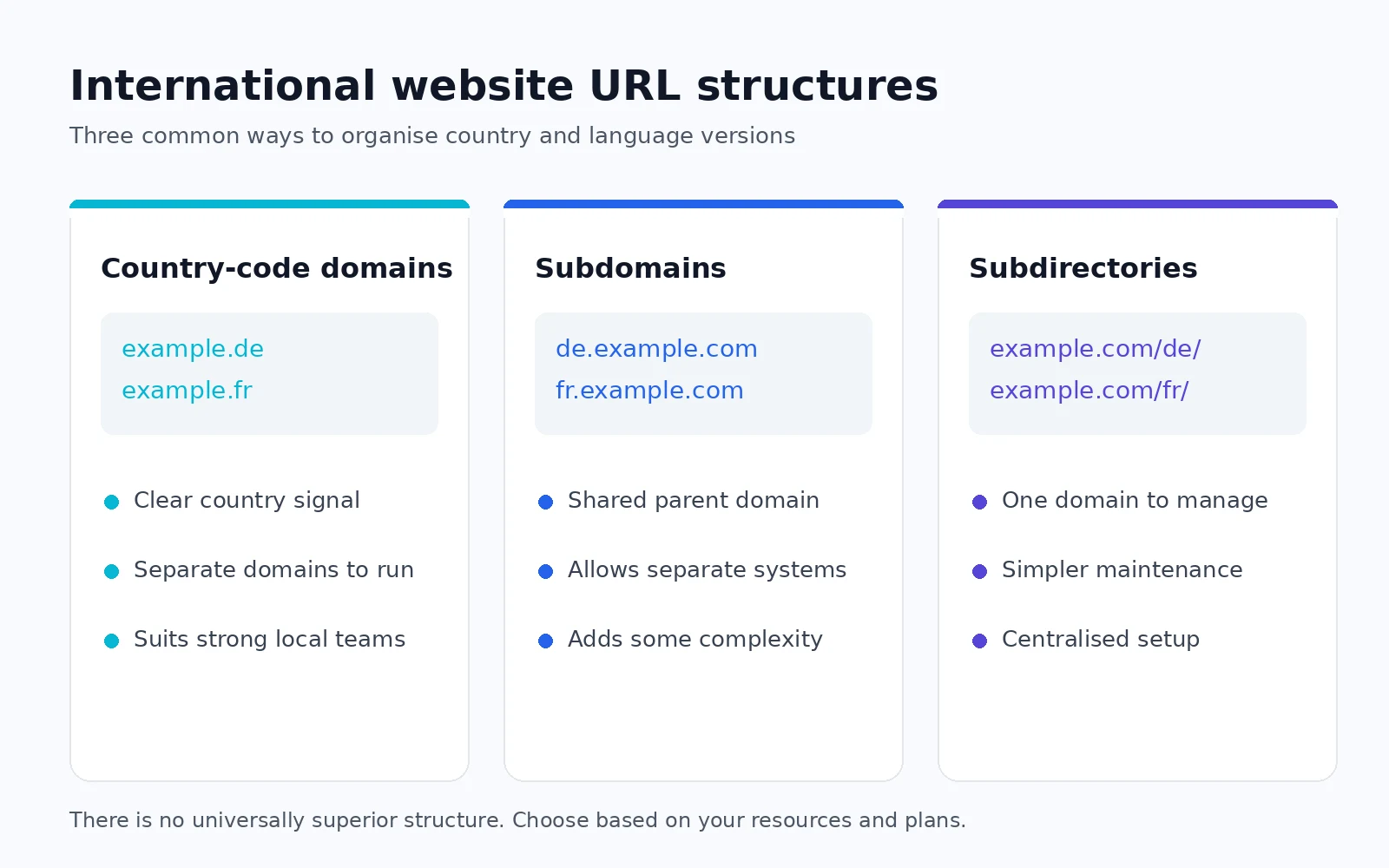
Your website's URL structure determines how country and language versions are organized. Three common options are country-code top-level domains, subdomains, and subdirectories.
Country-specific domains, such as example.de or example.fr, provide a clear geographical signal and can help establish a recognizable local identity. However, operating separate domains can increase infrastructure, content management, and marketing costs. This approach may suit businesses with substantial country-specific operations and dedicated local teams.
Subdomains, such as de.example.com or fr.example.com, allow businesses to separate markets while maintaining a common parent domain. They may be useful when different regions require distinct technical systems or content management arrangements, but can introduce additional operational complexity.
Subdirectories, such as example.com/de/ or example.com/fr/, organize localized content under a single domain. They are often practical for businesses that want centralized website management and can simplify technical maintenance.
There is no universally superior structure. Choose based on technical requirements, existing website architecture, available resources, and long-term business plans. Avoid changing an established structure without evaluating migration risks.
How to Implement Hreflang Correctly
Hreflang is an annotation that helps Google understand the language or regional alternatives of a webpage. It is especially useful when a website offers multiple versions of equivalent content.
Suppose a business operates https://example.com/us/product/ and https://example.com/uk/product/. The following annotations could appear in the HTML head of both pages:
<link rel="alternate" hreflang="en-US" href="https://example.com/us/product/" />
<link rel="alternate" hreflang="en-GB" href="https://example.com/uk/product/" />
Each page should reference itself and the corresponding alternative page. The annotations should also be reciprocal. Google supports hreflang implementation through HTML, HTTP headers, and XML sitemaps. Choose the method that is easiest to maintain correctly.
The x-default value identifies a fallback page for visitors whose language or region does not match the available alternatives. It can be useful for a global landing page or country selector, but not every website requires one.
Common mistakes include missing return annotations, invalid language or country codes, referencing redirected or unavailable pages, linking to unrelated content as regional alternatives, inconsistent URL references, and omitting relevant language versions. Hreflang does not guarantee rankings in a particular country; it helps Google understand the relationship between localized pages.
Hreflang and Canonical Tags
Canonical tags and hreflang annotations perform different functions. A canonical tag indicates a preferred URL among duplicate or substantially similar pages. Hreflang identifies language or regional alternatives.
When localized pages are intended to remain independently indexable, they should generally use appropriate self-referencing canonicals rather than canonicalizing every market version to one global page. There are exceptions involving substantially duplicated regional content, so canonical decisions should be reviewed against the actual page setup.
Website Localization Beyond Translation
Translation changes the language of content. Localization adapts the experience to the expectations of a specific market. A translated page can be grammatically accurate and still fail to address local customer needs.
Adapt regional terminology in product descriptions, service terminology, headings, navigation, and FAQs. Avoid relying entirely on direct translations of existing keywords.
Where relevant, localize pricing, currencies, taxes, shipping information, and payment options. For ecommerce businesses, customers may hesitate to purchase if delivery availability or final pricing is unclear. For SaaS companies, local billing information and relevant product documentation can help visitors evaluate the offering.
Regional visitors may look for country-specific support information, local delivery or service coverage, relevant legal and policy pages, appropriate contact options, localized product specifications, and authentic customer evidence from their market. Only display local offices, testimonials, certifications, or credentials when they genuinely exist.
Images, terminology, examples, and marketing messages may need adjustment. Legal requirements can also vary between countries. Consult appropriate legal or compliance professionals when dealing with privacy, consumer protection, accessibility, tax, or industry-specific obligations.
Technical SEO Checklist for International Websites
Even useful localized content can struggle to gain visibility when search engines cannot access or interpret it correctly.
Make every important market page crawlable. Avoid unnecessary blocking through robots.txt, restrictive authentication, or automatic location-based redirects.
Check indexability. Review whether important localized pages are eligible for indexing. Look for unintended noindex directives, incorrect canonicals, and inaccessible content. Google Search Console's URL Inspection tool can help investigate individual URLs.
Maintain accurate XML sitemaps. Include appropriate canonical, indexable URLs and keep sitemap references updated when localized pages are added, removed, or redirected.
Validate hreflang relationships. Check correct codes, valid URLs, and reciprocal references. A template-level implementation error can affect many pages, so test representative pages from every market.
Improve mobile usability and loading performance. Test important pages on mobile devices and monitor Core Web Vitals. Avoid unnecessarily heavy images, scripts, and third-party resources.
Provide visible language and country navigation. Visitors should be able to select the appropriate language or market. Do not force every visitor to a country-specific URL solely based on IP address, as redirects can prevent users and crawlers from accessing alternative versions.
Review internal linking. Localized pages should link naturally to other relevant pages within the same market where those pages exist.
Building Regional Trust and Authority
Technical optimization helps search engines understand your website, but users still need reasons to trust your business. Regional authority develops through useful content, credible references, and a reliable customer experience.
Publish content that addresses local needs. A business selling industrial equipment may need to explain regional product standards, shipping arrangements, or industry terminology. A SaaS company may need country-specific integration, billing, or compliance information. Create content because it answers a genuine local need, not simply because a new country folder exists.
Look for legitimate opportunities to earn references from relevant industry publications, professional associations, business partners, and authoritative resources. Avoid purchasing large quantities of low-quality links or creating artificial country-specific link networks.
Provide accurate business details, clear policies, accessible contact information, and truthful descriptions of your services. When your company does not have a physical office in a target country, do not imply that it does.
How to Measure International SEO Performance
International SEO performance should be evaluated by market rather than relying only on global website totals. A website can increase international traffic while failing to attract customers from its priority countries.
Use Google Search Console to monitor search impressions, organic clicks, queries, landing-page performance, and click-through rate. Review data using appropriate country and page filters.
Use your analytics platform to understand what visitors do after arriving. Relevant business outcomes may include qualified enquiries, demo requests, product purchases, trial registrations, contact-form submissions, and revenue attributed to relevant traffic.
Compare markets individually. For example, a reporting framework might track US clicks and impressions alongside qualified demo requests, UK search visibility alongside sales enquiries, and German landing-page engagement alongside trial registrations. This is an illustrative reporting structure, not actual campaign data.
Compare performance with each market's baseline, business goals, and investment level. Account for seasonality, search demand, and changes in website content when interpreting results.
Common International SEO Mistakes
International SEO projects often become unnecessarily expensive because businesses make structural decisions before validating demand.
Translating every page without research is a common mistake. Not every existing page deserves a localized equivalent. Prioritize content with demonstrated demand and a clear role in the customer journey.
Launching too many countries at once creates ongoing translation, technical, and content maintenance obligations. Start with a manageable number of markets and expand when the initial setup is stable.
Using incorrect hreflang codes causes implementation problems because country codes and language codes are not interchangeable. For example, en-GB identifies English content intended for the United Kingdom, while en-US identifies English content intended for the United States.
Creating duplicate country pages without a purpose offers little additional value when there are no meaningful regional differences. Also avoid ignoring conversion readiness: ranking in another country does not help much if customers cannot purchase, access the service, or contact your team.
Finally, do not measure only traffic. Monitor qualified conversions and commercial outcomes alongside search visibility.
International SEO Launch Checklist
Market research: Confirm the target audience and country; validate local search demand; review relevant competitors; assess delivery and support capabilities; prioritize commercially relevant pages.
Website architecture: Select a maintainable international URL structure; establish consistent language and region naming; plan internal navigation; define canonical URL rules; map corresponding localized pages.
Content and localization: Complete country-specific keyword research; adapt important landing pages; review local terminology; verify pricing, currency, and service information; check translations with appropriate language expertise.
Technical implementation: Validate hreflang annotations; confirm important pages are crawlable and indexable; review XML sitemaps; test mobile usability and loading performance; check redirects and broken links; confirm HTTPS and appropriate canonical tags.
Measurement: Configure relevant analytics events; establish country-specific reporting; record baseline search performance; define qualified conversion goals; schedule post-launch technical reviews.
Frequently Asked Questions About International SEO
International SEO focuses on reaching audiences across different countries or languages. Local SEO primarily focuses on improving visibility for searches associated with a particular geographic service area or physical business location.
No. Many businesses can manage multiple countries through subdirectories or subdomains under one domain. The appropriate structure depends on operational and technical requirements.
Hreflang is particularly useful when equivalent pages exist for different languages or regions. A website serving international customers through one universal page may not require it.
Yes. A single English-language website can reach audiences across several countries. Separate regional pages become more useful when search intent, terminology, products, pricing, or other important information differs.
Translation can make content accessible to new language audiences, but it does not guarantee rankings. Keyword relevance, localization, technical accessibility, competition, and content quality also matter.
There is no universal answer. Subdirectories are often convenient for centralized management, while country domains and subdomains may suit businesses with different operational requirements.
There is no fixed timeline. Results depend on competition, website history, technical quality, content relevance, market demand, and the extent of implementation. Evaluate progress using market-specific benchmarks rather than a guaranteed deadline.
Clear, accessible, relevant localized content can help search systems understand a business and its offerings. However, there is no guarantee that any specific page will appear in AI-generated answers or receive citations.
Build an International SEO Strategy Around Your Business Goals
International expansion works best when website decisions follow genuine market opportunities. Start by identifying where your customers are, how they search, and what they need before making major changes to your website.
Choose a sustainable URL structure, localize important content, implement the appropriate technical signals, and measure results by market. A focused approach gives your business a stronger foundation for reaching international customers while keeping ongoing website management practical.
If your business is preparing to enter new markets, explore EngineOptimization.in's International SEO services to discuss your target countries, website structure, and international search priorities.